Acquisition overview
This page answers one question: where did your users come from? Every card on it is keyed on the user's first touch — the campaign that found that person originally, not the one that brought them back today.
What this page counts#
Acquisition overview lives at /acquisition and attributes the users in the selected range to where they came from. The three metrics on the first card — Users, Sessions and Views — count the whole property over that range, and when period comparison is on they carry the change against the previous period.
Know this before you interpret anything on the page: every channel, source and medium breakdown here reads from the user's first touch. A first touch is the first time that visitor ever reached your site, and it stays attached to them permanently. So a customer who arrived six months ago from a Google ad and came back today from an Instagram ad is still a Google user on this page.
"Which channels put people into my funnel?" is this page's question. "What drove traffic this month?" is Traffic acquisition, which is session-scoped. Treating the two as interchangeable is the most common reason the numbers appear to disagree.
Source, medium, campaign and channel#
Four words this whole part of the product is built on, and the four most often confused:
| Term | The question it answers | Example values |
|---|---|---|
| Source | Where did the traffic come from? | google, instagram, digikala, newsletter |
| Medium | How did it arrive? | cpc, organic, email, referral |
| Campaign | Under which marketing action? | yalda-1404, retargeting-cart |
| Channel | Which readable bucket does it belong to? | Paid Search, Organic Social, Direct |
The first three are stored data. The collector derives them from utm_* parameters on the landing URL, from ad-network click IDs (gclid, fbclid, msclkid, ttclid and friends), and failing both, from the referrer. The order is fixed: a click ID beats utm_*, utm_* beats the referrer, and if none is present the visit is direct and is written with the canonical (direct) / (none) pair.
Channel is not stored data. It is a computation.
How a channel is decided#
Channel is derived from source, medium, campaign and click-ID type through an ordered ruleset. Three things about that ruleset matter:
- Rules are ordered and the first match wins. Evaluation starts with property-level rules, then account, then organization, then the platform defaults; within each layer, by ascending priority. The moment a rule matches, the rest are never consulted.
- If nothing matches, the channel is
Unassigned. That is not a bucket, it is a warning: something in your traffic the ruleset does not recognise. - It is computed when the report is read, not when the data is collected. This is the most important sentence on the page. Any change to the rules — adding a channel for a local ad network, reordering priorities — reclassifies history instantly. There is no reprocessing job and no data is rewritten; only the result of the computation changes. The only delay is a short cache on the compiled ruleset, held for about half a minute.
The platform defaults are evaluated in the same way. This table is what you consult when you want to know why some traffic landed where it did:
| Priority | Channel | Matches when |
|---|---|---|
| 1 | Direct |
no source and no medium — the (direct) / (none) pair |
| 2 | Cross-network |
the campaign name contains cross-network, or the click ID is wbraid / gbraid |
| 3 | Paid Shopping |
a shopping source or a shop-like campaign name, together with a paid signal on the medium |
| 4 | Paid Search |
a search source, together with a paid signal or a gclid / msclkid / yclid click ID |
| 5 | Paid Social |
a social source, together with a paid signal or fbclid / ttclid / twclid and similar |
| 6 | Paid Video |
a video source together with a paid signal |
| 7 | Display |
medium display / banner / cpm, or a dclid click ID |
| 8 | Paid Other |
the medium carries a paid signal but none of the buckets above matched |
| 9–12 | Organic Shopping / Organic Social / Organic Video / Organic Search |
the same source categories, without a paid signal |
| 13 | Referral |
medium referral / app / link |
| 14 | Email |
source or medium email, e-mail or newsletter |
| 15–18 | Affiliate / Audio / SMS / Push |
the medium names the channel itself — Push also matches a medium containing mobile or notification |
A "paid signal" means the medium matches the paid pattern: anything containing cp (cpc, cpm, cpv), or ppc, or starting with paid, or retargeting.
Source categories are a separate registry saying which domains count as search, social, shopping, video or ad network — and the regional ad networks (Yektanet, Tapsell) ship in the ad-network list alongside Taboola and Criteo.
Channel definitions are managed under Admin → Channel definitions (platform defaults) and are the AdPix platform administrator's to edit, not a business user's. If you need a new channel, ask for it with a sample of the source and medium values it should match; that single rule fixes the past and the future at once.
The cards#
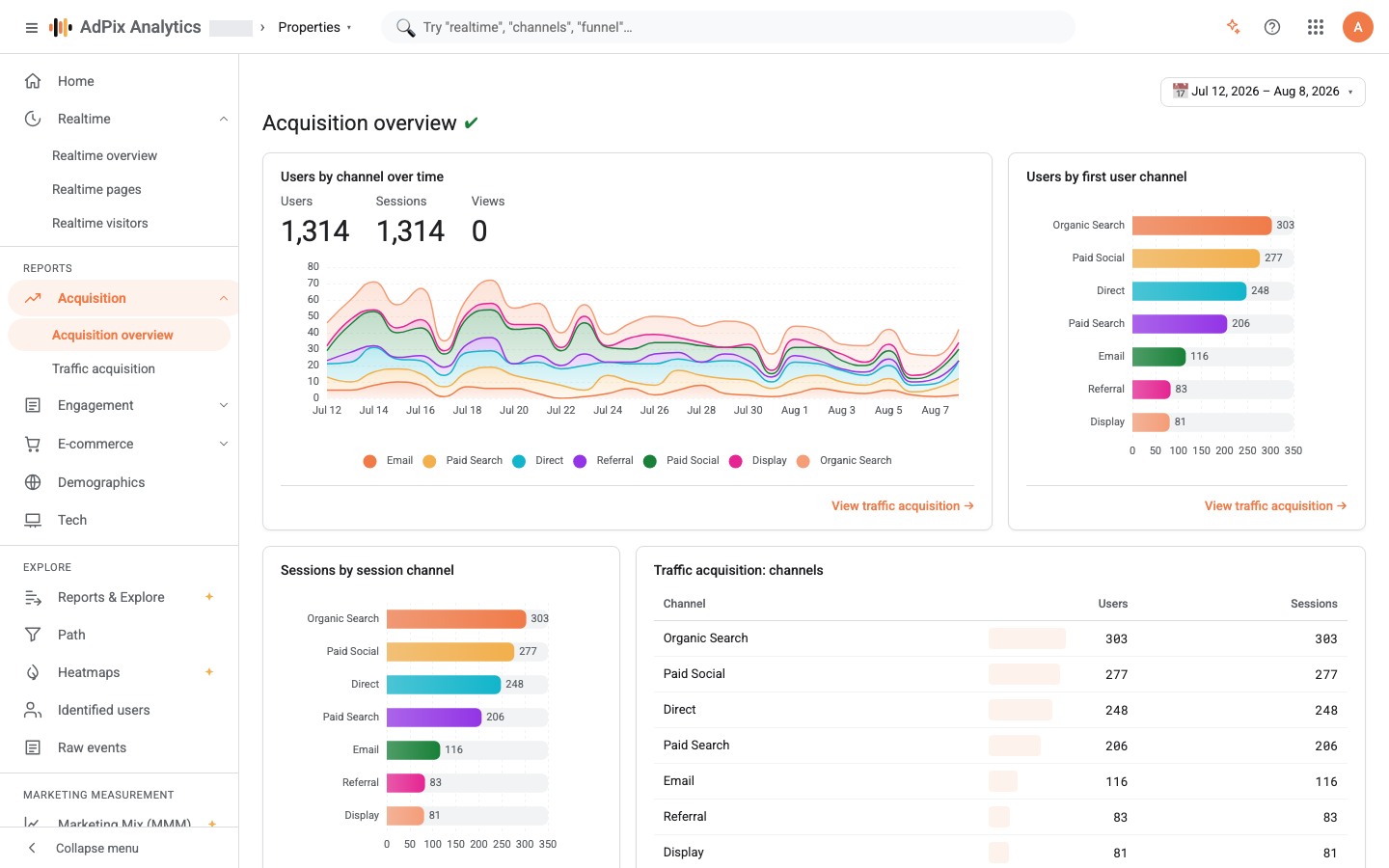
| Card | What it shows |
|---|---|
| Users by channel over time | a stacked area of daily users by channel, with the three headline metrics above it |
| Users by first user channel | the same channel breakdown as bars, measured in users |
| Sessions by session channel | the same breakdown, measured in sessions |
| Traffic acquisition: channels | a channel / users / sessions table with share bars, plus Download CSV |
| Top source / medium | the twenty busiest source-and-medium pairs by users |
The first three cards each carry a View traffic acquisition link in their footer, which takes you to the detailed session-scoped report.
The two bar cards are fed from one and the same rollup; what differs between them is the metric, not the scope — one counts unique users, the other counts sessions, both grouped by that user's first touch. When you need the channel that brought the session itself, Traffic acquisition is the right screen.
The CSV export#
Download CSV on the channel table exports what is on screen, with the channel resolved at export time. The file has eight columns — Channel, Channel Type, Source, Medium, Campaign, Users, Sessions, Pageviews — a Total row at the end, and a metadata block at the top carrying the property, the date range and the generation time. It is written with a BOM so Excel opens non-Latin text correctly.
A few things that change the interpretation#
- The range and the daily buckets are evaluated in the property's timezone. "Today" means your property's today, not UTC's. If days look shifted by one, check the property timezone first, under Admin → Property details.
- Test-mode events are not counted in any report.
- A return from a payment gateway is not an acquisition. The bank or gateway that sends the customer back after payment is demoted at collection time, and that visitor's durable last touch is restored. Without that, every successful sale would be credited to the payment processor and the ad channel that actually produced it would look unprofitable.
- Movement between your own domains is not a referral either. Domains and subdomains registered on the same property never count as an external referral.
If you want to weigh these origins against revenue and orders, the attribution report gives you the attribution models and the conversion window.
Frequently asked questions#
Why doesn't the channel number here match Traffic acquisition?
Because the two reports measure a different unit. This page attributes a user to their first touch; that one attributes each session to the touch that brought that session in. A returning customer stays under the old campaign here and appears under today's campaign there. Both are correct, and they answer different questions.
What does the Unassigned channel mean?
It means that traffic's source and medium matched no channel rule at all — neither yours nor the platform defaults. The usual cause is a custom utm_medium no rule covers. Add a rule for it; because channel is computed when the report is read, past traffic is reclassified straight away.
I added a channel. How long until it shows up?
There is no reprocessing step. The only delay is a short cache on the ruleset, held for about half a minute. Reload after that and history is already grouped under the new rule.
Why isn't a return from the payment gateway recorded as a new referral?
Because it is a return leg, not an acquisition. Banks and known payment gateways are demoted at collection time so they cannot erase the campaign that actually earned the sale, and that visitor's durable last touch is restored in its place.
Thanks — your feedback helps us improve the docs.